


The worst advice around a multipoint locking door is also the most common. People hear “more locking points” and assume they’ve bought more security, yet the true protection in a luxury entrance comes from the whole door set, not from the count stamped on the hardware. A strong lock in a weak frame is still a weak entrance, and on the Costa del Sol that matters just as much in a Marbella villa as it does in a Benahavís penthouse.
| Decision Point | What Matters Most | What Not to Overvalue |
|---|---|---|
| Main entrance security | Certified door set, frame anchoring, installation quality | Lock count alone |
| Weather performance | Perimeter compression, alignment, seals | “Heavy” hardware aesthetics |
| Smart access | Lifestyle fit, override behaviour, resilience | Tech features without backup |
| High-value properties | RC rating, frame strength, architectural integration | Marketing claims about bolt quantity |
Patent records show multi-point and multipoint door-lock designs going back decades, including documented work from the 1980s and a later patent family with a 2000 priority date, so this is not some new miracle product that suddenly solved entrance security patent record. The significant shift is that multipoint locking has moved from specialist hardware into mainstream luxury specification, with a global market valued at USD 0.27 billion in 2024, rising to USD 0.29 billion in 2025 and projected to reach USD 0.38 billion by 2033, implying a 5.4% CAGR from 2025 to 2033 market study. That growth says something simple. Clients want better sealing, better resistance to forced entry, and a cleaner finish, but they still need the right system, installed correctly.
For architects and homeowners specifying high-end doors, the better question is not “how many locking points does it have?” The better question is “what is the door set certified to do, and how well will it stay aligned after installation, weather, and normal use?” That’s where real performance starts.
Table of Contents
- Why More Locking Points Are Not Always More Security
- How a Multipoint Locking Door Mechanism Works
- Manual, Electromechanical and Hybrid Systems Compared
- Force Distribution, Weather Sealing and Certified Performance
- Installation Practices That Make or Break the Lock
- Combining Multipoint Locks with RC, Fire and Ballistic Ratings
- Maintenance Routines That Preserve Lock Integrity Over Years
- Specifying the Right Multipoint Locking Door for Your Property
Why More Locking Points Are Not Always More Security
A multipoint locking door can be the right choice, but only when the rest of the assembly deserves it. If the frame is weak, the anchoring is poor, or the leaf is badly detailed, extra locking points just spread the problem around instead of solving it. That is why certified door-set performance matters more than a brochure that celebrates bolt count.
The door set carries the risk, not the lock alone
Testing standards are built around the complete assembly, because burglars attack the door, the frame, the hinges and the surrounding structure, not just the gearbox. EN 1627 burglary-resistance classes use defined attack times and tools, which is far more useful than a vague claim about “multiple locking points.” The lock helps, but the system has to absorb the load.
Practical rule: if the frame can’t carry the force, the lock can’t save it.
That point matters in luxury homes across Marbella, Estepona and Sotogrande, where glazing, side panels, bespoke thresholds and large formats often create weak links outside the hardware itself. A strong mechanism on an under-anchored frame can look premium and still perform badly. On a villa entrance, the wrong detail at the perimeter can dominate the risk profile.
Security is only one part of the brief
Owners often want a door that feels solid, seals well and looks discreet. That’s reasonable, but those goals don’t always align with raw lock complexity. A properly specified multipoint system can improve resistance to prying and distribute load, yet it can also be chosen mainly for sealing and operational consistency when the threat level doesn’t justify a heavier certified package.
For this reason, the security conversation should start with the property, not the product. A penthouse entrance, a side door to a rooftop terrace, and a safe-room leaf all ask for different answers. The lock is one component in a wider decision about risk, occupancy, and the quality of the surrounding build. For a practical breakdown of how intruders exploit weak points, see how burglars break into homes.
How a Multipoint Locking Door Mechanism Works

What happens when the handle is lifted
A multipoint mechanism secures the door at several points along the edge simultaneously, usually with a mix of hooks, rollers and a deadbolt spaced from top to bottom of the leaf mechanism description. The sequence is straightforward. Lifting the handle drives the side locking elements into their matching keeps, and turning the key then engages the deadbolt for additional resistance.
That geometry changes how the door loads the frame. Instead of concentrating force at one latch position, the system pulls the leaf into several locations at once. In premium systems, automatic latch bolts can throw 20 mm, which helps compress the door evenly into its seals and keeps the action consistent over the full height of the leaf technical specification.
The lock is only one part of the security picture. A well-made mechanism can resist prying and improve load distribution, but its benefit drops fast if the frame, anchoring and surrounding door set are weak. On a luxury door, the hardware must work with the structure, not compensate for poor structure.
Three-point, five-point and higher-count systems
The core issue is not how many points the lock has, but where those points sit. Many multipoint locks use three or more locking points, and some are described as having three, five or more locking elements door lock overview. A true three-point arrangement secures the top, centre and bottom of the door. More points can help, but only when they are properly distributed and matched to the door size.
For larger or heavier doors, the hardware layout matters as much as the mechanism itself. Premium systems are built around load distribution and compatibility with the leaf, the frame and the profile geometry. Read the specification sheet as an engineering document, not as a sales sheet. If the dimensions do not work, the system does not belong on the door.
A multipoint lock should close the door into the frame, not force the frame to absorb what the door cannot carry.
Manual, Electromechanical and Hybrid Systems Compared
The right mechanism is the one that fits the client’s life, not the one that sounds most advanced. For a year-round family residence in Marbella, a seasonal villa in Sotogrande, and a smart penthouse in Benahavís, the answer won’t be identical. The right choice depends on daily use, tolerance for maintenance, and whether access control needs to integrate with the wider home.
| Property Scenario | Recommended Mechanism | Key Benefits | Trade-offs to Consider |
|---|---|---|---|
| Year-round villa in Marbella | Manual multipoint lock | Simple operation, reliable, minimal maintenance | No native smart access |
| Seasonal villa in Sotogrande | Hybrid multipoint system | Key override plus motorised convenience | More components, more specification discipline |
| Smart penthouse in Benahavís | Electromechanical multipoint lock | Keypads, fingerprint readers, mobile credentials, access control integration | Depends on power and electronic coordination |
Manual, for owners who want simplicity
Manual multipoint locks remain the right answer when reliability and low maintenance matter most. They suit owners who want a straightforward mechanical routine and don’t need an app, credential reader or external access platform. For many high-end doors, that is the cleanest solution.
Electromechanical, for integrated living
Electromechanical systems suit homes where the entrance must work with smart home controls, keypad entry, fingerprint readers or mobile devices. They keep the mechanical locking function, but add a powered way to engage or release it. In a modern apartment or a villa with professional access control, that can be very practical.
Hybrid, for resilience without sacrificing convenience
Hybrid systems often make the most sense in luxury villas. They combine motorised convenience with a traditional key override, so the door still has a mechanical fallback if power or electronics fail. That is not a luxury add-on, it’s a resilience decision.
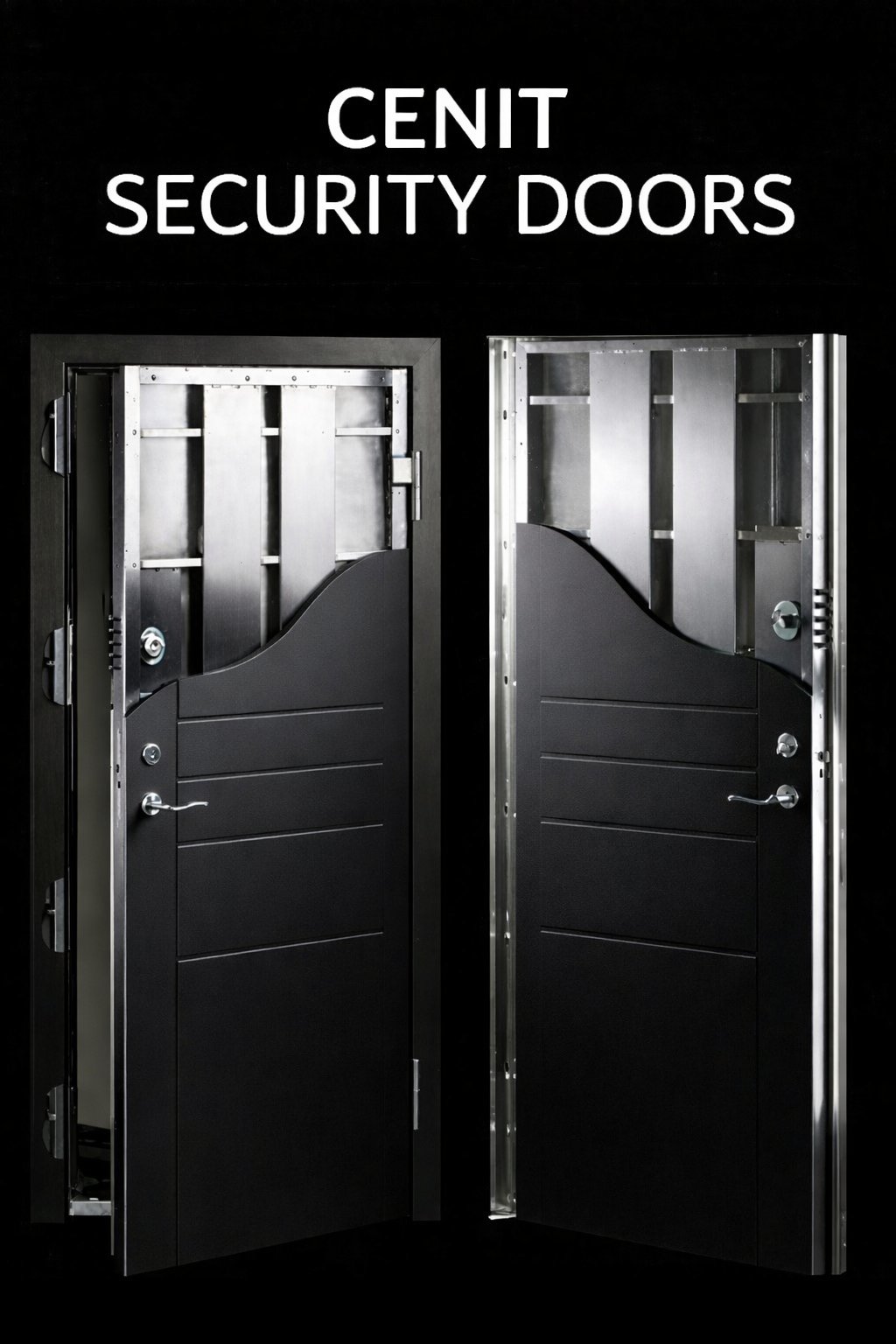
For bespoke projects, Cenit Security Doors S.L specifies multipoint locking within fully made-to-order door systems, which is the right place for it when the mechanism has to work with reinforced structure, architectural finishes and the rest of the hardware package. The lock choice should follow the lifestyle brief, not the marketing tier.
Force Distribution, Weather Sealing and Certified Performance
A multipoint system changes how the door behaves in two practical ways. It spreads force across the frame, and it compresses the perimeter more evenly. Those effects matter every day, not only during a forced-entry attempt.
Why the load moves differently
A conventional single-point lock concentrates stress around one lock position. Multipoint geometry moves that load into several locations along the edge, which is why these systems are used in higher-security and wind-load applications, not just for convenience. Hook bolts, shoot bolts and deadbolts work together to hold the leaf more evenly, and the broader door system described in the engineering spec shows how that load path is meant to be controlled.
That said, no one should confuse lock count with certified resistance. Security doors should be judged against recognised standards such as PAS 24, LPS 1175 and EN 1627 resistance classes, not by the number of moving parts. The standard tells the client what the complete door set has been tested to resist. The lock count does not.
Why sealing is part of the security conversation
Multiple locking points also improve compression around the perimeter, which helps the door sit tighter in its seals and reduces movement. In coastal properties on the Costa del Sol, that matters because a better-sealed door is easier to live with, especially where exposure, wind and regular opening cycles are part of normal use. It is a functional improvement, not just a security one.
For a closer look at how structure and certification fit together, see how security doors are engineered. The point is simple. The lock is only one part of a certified assembly, and the frame, leaf and test result deserve equal attention.
A multipoint door is worth specifying when the frame, leaf and certification work together. Otherwise, it is just expensive hardware.
Installation Practices That Make or Break the Lock

A perfect lock can still feel terrible if the installation is poor. That is the part too many luxury projects get wrong. Architectural tolerance is tight, but door hardware needs even tighter discipline if the system is going to operate smoothly for years.
The frame has to be right first
The frame needs to be square, level and securely fixed to the surrounding structure. Every keep has to align precisely with its locking point, and the perimeter gaps need to stay consistent. If the geometry is off, the handle will feel heavy, the bolts won’t engage cleanly and the weather seals won’t compress evenly.
Hinge adjustment is not optional
The hinges determine whether the leaf meets the frame in a controlled way or jams against it. Adjust them properly, and the lock will engage without excessive force. Ignore them, and even a premium multipoint system starts to feel crude.
Testing before handover protects the client
Every locking point should be tested repeatedly before handover, then checked again after installation to allow for normal building settlement. That last point matters more in new builds and major renovations, where the structure may still move slightly. A door that was aligned on day one can drift out of tolerance if nobody checks it later.
A disciplined installer treats the lock, frame and seals as one system. That is the only way a bespoke door keeps its feel, finish and performance in a luxury interior.
Combining Multipoint Locks with RC, Fire and Ballistic Ratings
Multipoint locking is rarely the entire specification. In high-end properties, it often sits inside a wider package that also needs burglary resistance, fire performance and sometimes ballistic protection. The right question is not whether the lock can do everything. It can’t. The question is whether the full door set is engineered for the risk.
Where the lock supports certified resistance
Cenit Security Doors discusses RC3, RC4 and RC6 security door ratings because these classifications describe the behaviour of the complete door set, not just the hardware. The lock contributes, but the frame, leaf, reinforcement and installation decide whether the system really belongs in that class. That distinction matters in apartments, villas and protected internal zones.
For fire-rated security doors, the same logic applies. A lock does not create a fire rating on its own, and a ballistic configuration does not come from the gearbox alone. The certification comes from the tested assembly. In practice, that means the designer has to balance structure, sealing, ironmongery and finish from the start.
When a combined specification is justified
Combined systems make sense where the property has more than one risk profile. A main entrance may need burglary resistance. An internal security door may need to create a protected zone around valuables, a study or a wine room. A safe room may need a different level of physical and life-safety performance again.
That is where multipoint locking earns its place. It helps support a secure perimeter on complex doors, especially where the design brief includes RC3, RC4, RC6, fire-rated performance up to 120 minutes, or ballistic options such as FB4 and FB6. The lock is not the headline. The specification is.
Maintenance Routines That Preserve Lock Integrity Over Years

Keep the mechanism clean and correctly lubricated
Dust, grit and coastal air all shorten the life of precision hardware. The faceplate, keeps and frame should stay clean and free from debris, and only the components recommended by the manufacturer should be lubricated. If a high-use door starts feeling stiff, forcing it is the wrong answer.
Check alignment before it becomes a fault
Hinges need periodic inspection so the leaf stays correctly aligned. If the door begins to drag, the lock will suffer long before the owner notices anything dramatic. That is usually a geometry problem, not a lock problem.
Service the door as a system
High-use doors should be professionally serviced every few years. A specialist can clean the moving parts, adjust the alignment and confirm that all locking points engage properly. Certified systems should never be modified with incompatible hardware, especially on fire-rated or certified security doors.
A small amount of routine care protects the original specification and avoids rough operation later. On a bespoke luxury door, that matters because maintenance is part of the asset, not an afterthought.
Specifying the Right Multipoint Locking Door for Your Property
The right specification starts with the building, not the catalogue. A villa in Marbella, a penthouse in Benahavís, a coastal home in Estepona or a development in Sotogrande will each ask for a different balance of convenience, resilience and certification. The lock type should follow the lifestyle and the risk profile, not the other way around.
For most luxury projects, the most sensible rule is this. The security of the complete door set matters more than the locking mechanism alone. That means the reinforced frame, hinges, locking points and installation all have to be correct. If one of those is weak, the system is weaker than the brochure suggests.
A multipoint locking door is worth specifying when it improves the whole assembly, not when it adds visual complexity. If the brief includes smart access, choose electromechanical or hybrid. If the brief values simplicity and low maintenance, manual is still a sound decision. If the project needs RC ratings, fire performance or ballistic protection, the lock must be integrated into a tested bespoke system from the outset.
For a private specification review, contact Cenit Security Doors S.L and discuss a multipoint locking door built around your property, your risk profile and your architectural finish. Visit Cenit Security Doors S.L to arrange a consultation for luxury homes, apartments and developments across the Costa del Sol.